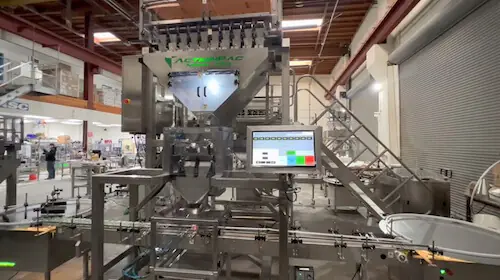
An automated packaging machine can cost anywhere from a few thousand dollars to several hundred thousand dollars. The range is wide because packaging machines solve very different problems. A basic machine may automate one step in production. A complete packaging system can weigh, fill, seal, label and move products automatically.
Product type also makes a major difference. Packaging coffee is different from packaging cannabis flower, powders or fragile products. That is why the better question is not simply, “How much does a packaging machine cost?”
The better question is: What level of automation does your operation need? Understanding that first can help you estimate both cost and potential return.
What Is the Average Cost of an Automated Packaging Machine?
General market pricing for commercial packaging equipment can range from roughly $10,000 to $150,000 for many automated systems. Complex industrial packaging lines can reach $500,000 or more. These figures are broad industry ranges. They are not ActionPac pricing.
Smaller or semi-automatic machines generally fall toward the lower end. Fully automated and custom-integrated systems move toward the higher end. Several factors determine where your project will fall.
These include:
- Product characteristics
- Packaging format
- Required production speed
- Weight accuracy
- Level of automation
- Sanitary requirements
- Custom engineering
- Additional equipment integrations
Two companies packaging similar products can still need very different systems. That is why equipment pricing usually starts with the application.
What Affects Automated Packaging Machine Cost?
1. The Product You Need to Package
Your product affects almost every part of system design. Free-flowing products may move easily through standard equipment. Sticky, fragile or irregular products can require more specialized handling.
Powders create another challenge. Their flow characteristics can change significantly between materials. Cannabis flower also requires careful handling. Large buds, small buds and infused products behave differently during weighing and filling.
A packaging system must account for these characteristics. Otherwise, faster equipment may simply create more waste or inconsistent packages. Testing the actual product is often an important part of system design.
2. Your Required Packaging Speed
Throughput has a major effect on equipment cost. A company filling a few packages each minute has different needs than one producing thousands each hour. Higher speeds can require additional weighing capacity, conveyors, controls and downstream equipment.
However, buying the fastest machine available is not always the best choice. The system should match your actual production goals. That includes current demand and expected growth. A properly sized machine gives you enough capacity without paying for unnecessary complexity.
3. The Level of Automation
Packaging automation exists on a spectrum. A semi-automatic system may automate weighing or filling while operators handle containers manually. A fully automated line may manage several processes with limited operator involvement.
For example, one system could combine:
- Product feeding
- Weighing
- Filling
- Container handling
- Sealing
- Labeling
- Inspection
Every additional process changes the equipment requirements. This is why a standalone machine costs less than a complete turnkey packaging line.
You also do not need to automate everything at once. For many operations, automating the biggest bottleneck first provides the strongest starting point.
4. Accuracy and Weight Requirements
Speed gets attention, but accuracy can have an even greater financial impact. Consider a business that sells product by weight.
Every package that receives more product than required creates product giveaway. One package may not seem significant. Thousands or millions of packages can make that loss expensive.
Underweight packages create a different problem. They may require rework and can create compliance concerns in regulated markets. The right weighing system must balance throughput with accuracy.
For high-value products, small improvements in weight control can have a meaningful impact on margins. This is one reason precision weighing remains central to ActionPac packaging systems.
5. Packaging Format
The container itself also affects cost. Your operation may package products into:
- Bags
- Pouches
- Jars
- Bottles
- Boxes
- Pre-roll cones
- Bulk containers
Each format can require different equipment. A jar line may need indexing and capping equipment. A pouch system may require bag opening and sealing equipment. Some applications also require gas flushing, inspection or other processes.
Changing between several package formats adds another consideration. Equipment designed around flexible changeovers may cost more initially. However, that flexibility can provide greater value as product lines grow.
6. Customization and Integration
Not every packaging challenge can be solved with standard equipment. Existing production lines may need new equipment integrated into current machinery. Other operations need custom controls, conveyors or product handling.
The physical facility matters too. Available floor space, electrical requirements and compressed air can influence system design.
This is where working directly with an equipment manufacturer becomes valuable. Instead of fitting your process around a standard machine, the equipment can be configured around your production needs.
What Other Packaging Automation Costs Should You Consider?
The machine purchase price is only part of the investment. Companies should evaluate the complete implementation. That can include installation, training, freight and facility preparation. Future maintenance and replacement parts also matter.
Packaging materials remain an ongoing operating expense. Integration can create additional costs when several machines must communicate with each other. These expenses should be identified early.
A lower purchase price does not always mean a lower total cost. A system that creates frequent downtime or excessive product waste can become expensive over time.
How Do You Calculate the ROI of Packaging Automation?
The most useful way to evaluate automation is to compare its cost against your current process. Start with labor. How many people work on packaging during each shift?
Then consider production. How many finished packages can the current process produce each hour? Next, look at losses. Measure product giveaway, damaged packages, rejected products and rework.
Finally, consider growth. Could your current packaging process support significantly more orders without adding another shift? These numbers create a baseline.
A simple packaging automation ROI calculation can start with:
Annual automation savings = labor savings + reduced product loss + reduced rework + additional production value
Those savings can then be compared with the total automation investment.
Not every benefit appears directly on a spreadsheet. Automation can also make production more predictable. It can reduce dependence on repetitive manual processes and give skilled employees more valuable work.
When Does Automation Become Worth the Investment?
Automation becomes attractive when manual packaging starts limiting the business. Maybe production cannot keep pace with orders. Maybe labor costs continue rising. Perhaps weight inconsistencies are hurting margins. Or your packaging department needs more employees every time sales increase.
Those are signs that the economics may be changing. The right point is different for every operation.
A company does not need to reach a certain revenue level before considering automation. It needs a repeatable production problem that automation can solve.
If you are unsure whether you have reached that point, read our guide on when it is time to automate your packaging process.
Should You Buy a Packaging Machine or a Packaging Solution?
Price comparisons become difficult when every machine is treated as interchangeable. They are not.
A packaging machine is one piece of equipment. A packaging solution considers the complete process around that machine. That includes your product, target weight, package, throughput, operators and facility.
It also considers what happens next. Can the system scale? Can other equipment be integrated later? Can your team get technical help when production problems appear?
These questions affect the long-term value of your investment.
Why Work With ActionPac?
ActionPac designs automated packaging solutions around real production requirements. Our approach begins with the application.
We look at the product, target weight, package format and production goals. Then we determine what level of automation makes sense. Solutions can range from individual equipment to integrated turnkey systems.
ActionPac packaging equipment is engineered in the USA. Our team includes in-house mechanical, electrical and programming expertise.
That direct engineering relationship matters when an application is difficult. It also matters years after installation. We support ActionPac equipment for the long term because packaging automation should be a business investment, not simply an equipment purchase.
Get an Accurate Packaging Automation Cost
Online price ranges can provide a starting point. They cannot tell you what your packaging process actually needs. The most accurate estimate comes from evaluating your product and production goals.
Before requesting a quote, gather four pieces of information:
- The product you need to package
- Your package type and size
- Your target weight
- Your desired production rate
To provide a quote for complex systems, ActionPac typically asks for:
- Clear photos of the product from several angles
- A short video showing how the product moves, stacks, nests, or is currently handled
- Product dimensions, weight, and material
- Photos and dimensions of the finished package
- The quantity or weight required per package
- Desired production speed
- A description or video of the current packaging process
- Available floor space and any important facility limitations
- Your preferred project timeline
Those details give an equipment manufacturer a much clearer starting point. They also help prevent both underbuilding and overbuilding your packaging line.
The goal is not to buy the most automation. The goal is to invest in the right automation for your operation.
ActionPac builds the world’s most efficient automated packaging equipment
Get a Quote
Frequently Asked Questions
How much does a fully automated packaging machine cost?
Fully automated packaging equipment varies widely in price. Commercial systems can range from tens of thousands to hundreds of thousands of dollars. Complex integrated lines can cost more. Product type, speed, packaging format and customization all affect pricing.
Why are automated packaging machines expensive?
Industrial packaging machines combine mechanical systems, controls, sensors and specialized components. Higher speeds and tighter accuracy can require more advanced engineering. Customization and line integration can also increase the investment.
Is packaging automation worth the cost?
It can be when automation reduces labor, product waste or production bottlenecks. The best way to evaluate the investment is through ROI rather than purchase price alone.
Can I automate only part of my packaging process?
Yes. Partial automation is often a practical starting point. Businesses can automate a major bottleneck first, then expand automation as production grows.
How do I get an accurate packaging machine quote?
Provide the manufacturer with your product, target weight, package format and required throughput. Actual product testing may also be useful for difficult materials.